When My Server Turned Into a Drama Queen — My Blue-Green Deployment Journey
By Abhinav Singh, Software Engineer
Every developer has that one traumatic experience that changes how they deploy forever. Mine? Let’s just say my server had the emotional stability of a college Wi-Fi connection during exams. 😩
Picture this: I push new code, proudly run my deployment, and… poof! Website down. Monitoring alert: “Your service is unreachable.” My users: “Bro, did you delete the internet?” Me: silently staring at the terminal wondering if I should start applying for a non-tech job.
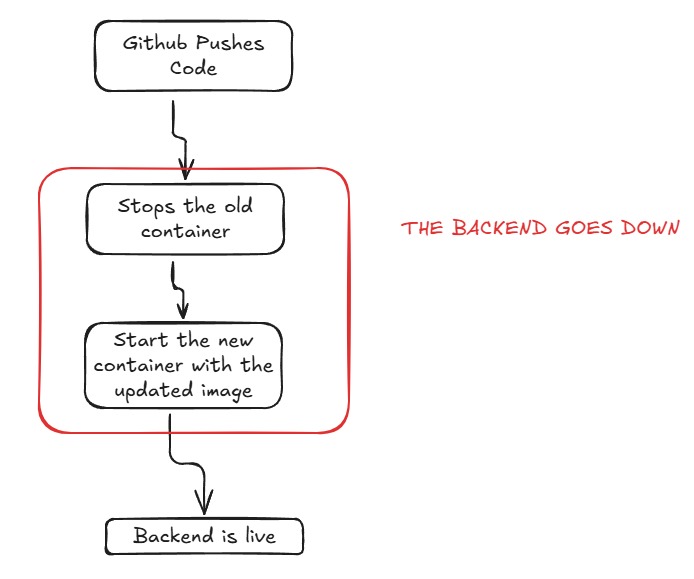
The problem was simple — I was using Docker for my frontend (Vite) and backend (FastAPI), all running on my self-hosted Ubuntu VPS. Whenever I deployed, I had to stop the old containers to start new ones. And while those new containers were building, my site would go completely offline.
For those few painful minutes, I felt like the guy in production memes who says:
“It works on my local.”
🧠 The Pain of Traditional Deployments
If you’ve ever done manual Docker deployments, you know that pain.
You stop one container, pull a new image, run it, and hope everything works. But in between those steps — there’s this awkward, silent downtime where your backend just vanishes.
It’s that moment when:
- Your site is 404-ing harder than your old startup idea.
- Your uptime monitor sends more emails than your crush ever did.
- And you start questioning life decisions like, “Why didn’t I just deploy on Vercel?”
That’s when I realized: I wasn’t deploying code… I was performing surgery on a live server without anesthesia. 😭
⚙️ Discovery — The “Aha!” Moment
One night, I finally decided to fix it and chose Blue Green Deployment strategy.
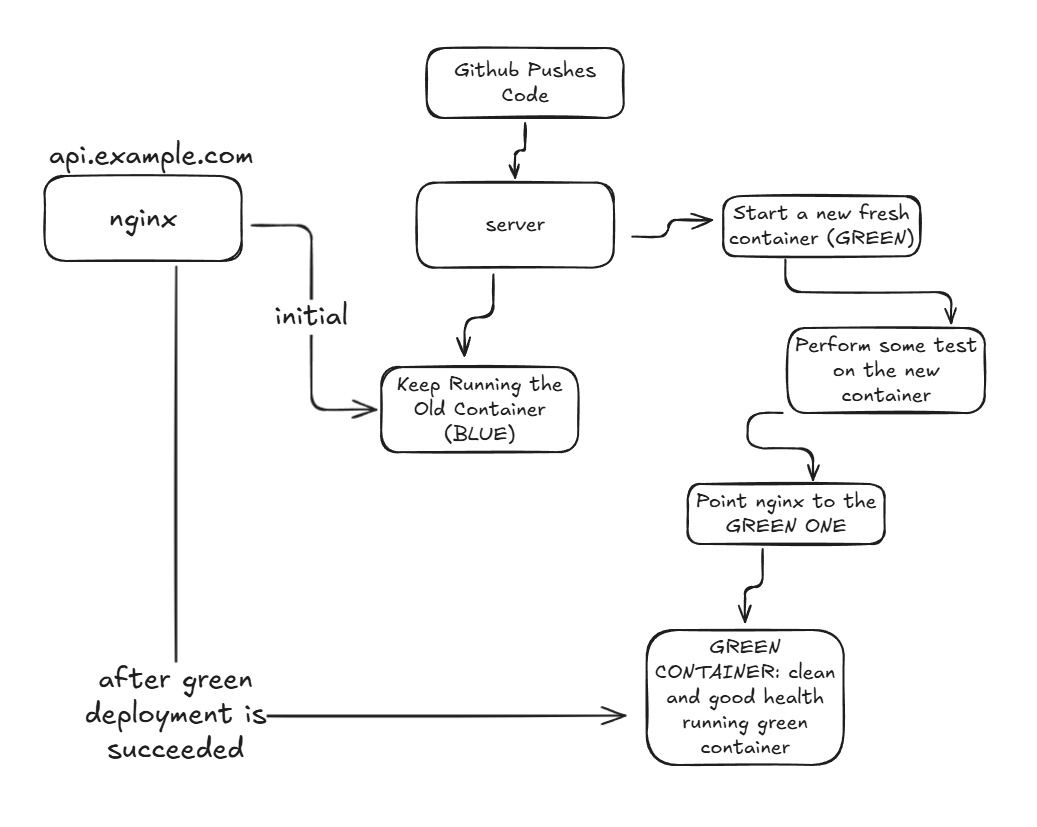
The idea is genius in its simplicity: You have two identical environments, called Blue and Green. One is live, one is idle. You deploy to the idle one, test it, and when everything looks good, you switch traffic.
No downtime. No panic. No crying in your terminal.
You might be thinking,
“Wait, you’re telling me I can deploy without destroying my live app first?”
Yes, that was it. The lightbulb moment 💡.
I was going to do this. My server deserved peace.
🧩 My Setup — Simple, but Effective
I had:
- Frontend: Built using Vite
- Backend: FastAPI
- Proxy: NGINX reverse proxy
- Infrastructure: My trusty Ubuntu VPS
- Containers: Dockerized frontend and backend
That was my playground. All I had to do was create two environments — one Blue, one Green — and make them live in harmony.
It felt like becoming the DevOps version of Thanos:
“Perfectly balanced, as all deployments should be.” 😎
🛠️ Building the Blue-Green Magic
So, I started implementing it step by step. No complex tools, no cloud magic — just smart configuration.
Now, when I want to deploy, I don’t destroy the existing one. I build my new version (the Green one), let it run quietly in the background, test it, sip some coffee ☕, and when I’m satisfied… I simply tell NGINX: “Hey, send everyone to Green now.”
And guess what happens? Traffic switches. Instantly. Users don’t even notice. Zero downtime.
The best part? If anything breaks, I can just say:
“No worries, let’s go back to Blue.” Boom — rollback in seconds.
Earlier, my deployments used to feel like playing Russian Roulette with Docker. Now, it’s like flipping a light switch.
📊 Before vs After — My Deployment Glow-Up
| Experience | Before Blue-Green | After Blue-Green |
|---|---|---|
| Server uptime | Randomly crying | Smooth as butter 🧈 |
| Deployment time | 5–10 mins of chaos | 2 mins of calm switching |
| Rollback | Full rebuild nightmare | One flip, done ✅ |
| My mental state | “Why me?” | “I got this.” 😎 |
| Team chat during deploy | “Is it down again?” | “Wait… it’s already live?” |
🤓 Why Developers Should Care
Because downtime is not cool — no matter how indie or small your project is.
If you’re running anything self-hosted (and you like your sanity), you need Blue-Green Deployment.
It’s not about fancy infra or expensive tools. It’s about being smart and avoiding those 2 AM production meltdowns.
It’s that rare deployment method where you can actually say:
“I deployed on Friday and went out for dinner.”
🧠 Lessons Learned
- Never trust a single container — always have a backup running.
- Automate traffic switching — humans are great, but NGINX reloads faster.
- Logs don’t lie — always keep an eye on them post-deployment.
- Downtime is optional — seriously, it’s 2025, not 2015.
- Being a good dev is not just about writing code, it’s about building confidence in your systems.
💬 Final Thoughts — From Chaos to Calm
Looking back, Blue-Green Deployment wasn’t just a technical upgrade. It was a mindset shift.
It taught me that great developers don’t just write code — they design reliable experiences. Because users don’t care about your tech stack. They care that your app works every single time.
Now, deployments for me are smooth, silent, and peaceful. No drama. No panic. No downtime.
Just one small flip, and a confident smile 😌.
So, if you’re still stopping your server every time you deploy, consider this your sign. Try Blue-Green Deployment.
Because, trust me — boring deployments are the best kind of deployments.